Published March 2026, based on analysis carried out January – February 2026
Cities are the engines of the global economy – and they are proving remarkably hard to derail. Despite tariffs, trade wars and geopolitical tension, cities continue to thrive.
The Savills Resilient Cities Index, now in its 7th year, measures cities that successfully balance economic goals with social and environmental objectives in ways that attract investors, developers and, critically, the individuals and businesses whose location preferences drive demand. They do this in many unique ways: some planned, some organic.
Traditional economic powerhouses dominate the rankings. New York, Tokyo, London and Seoul take the first four places, just as they did in 2024.
A host of interesting stories is also emerging. US cities make up 10 of the top 20 and enjoy a significant upward trajectory. Dublin – up five places year-on-year – is the single major European mover in the top 20.
Resilience is not a fixed state: forward-thinking cities must seize the opportunity to deliver the resilient buildings and infrastructure that will ensure their success – now and in the future. As our 2026 Impacts theme of ‘Deliver’ highlights, it’s time for action.
Resilient Cities Index – global top 20
Source: Savills Research
What is city resilience?
Broadly, resilience is the ability of cities – comprising individuals, communities, institutions, businesses and systems – to meet current challenges and adapt to new ones as they emerge.
The Index assesses cities across four pillars: economic fundamentals; knowledge economy and tech; environmental, social and governance; and real estate. Throughout this, we find cities delivering innovative solutions in one or more of these pillars, often despite significant challenges.
Delivering resilience: urban economies
When it comes to resilience, scale matters. Megacities such as our top four of New York, Tokyo, London and Seoul create virtuous circles of supply and demand. Innovation and culture germinate freely. These megacities exert a gravitational pull over their surrounding regions, drawing in talent, capital and occupiers.
Beyond these cities, key trends include ambitious social infrastructure delivery, Southern Europe’s broad-based economic resurgence and the pooling of talent in Asia’s growth hubs.
Spain leads Southern Europe’s resurgence
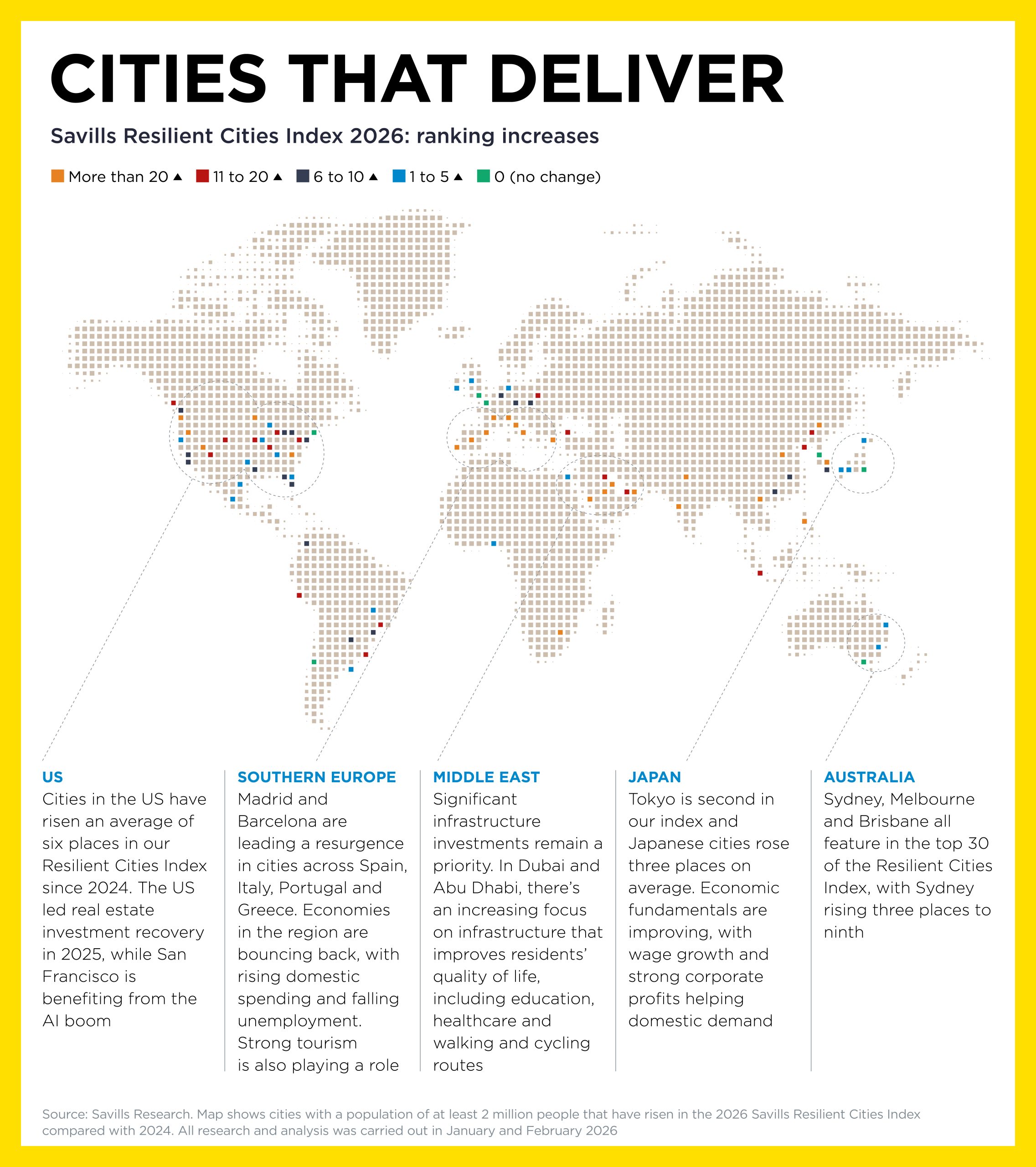
While Spain’s largest cities – Madrid and Barcelona – aren’t megacities, they exert significant influence over their respective regions and are leading a Southern European resurgence. Cities in Spain, Italy, Portugal and Greece have risen an average of 36 places in our index since 2024.
Some of this is cyclical growth, but much isn’t. Tourism is perhaps the most obvious factor: visitor numbers are strong.
Culture and lifestyle also play a role. More people in Southern Europe shop in person, fewer work from home and more eat out than elsewhere on the continent, supporting footfall and commercial occupier demand.
But the causes of the resurgence run deeper. Southern European economies are catching up after contractions earlier in the decade. This is supported by a shift toward higher-value sectors and increased domestic spending that has pushed down unemployment and boosted growth.
Spanish GDP growth – which the IMF estimate will be 2.9% for 2025 – is well above the EU average. Meanwhile, skilled immigration into Madrid and Barcelona has risen, mainly from other parts of Spain but also thanks to significant international arrivals, including overseas students.
For real estate, the effects are tangible. Both cities have become key markets for global retail operators, and Madrid is refurbishing its hotel stock. The Spanish capital has also seen the emergence of a super-prime housing sector for the first time.
Jaime Pascual-Sanchiz, CEO of Savills Iberia, says: “While part of Southern Europe’s momentum can be attributed to the economic cycle, the truly material shift lies in the structural forces that are redefining the region’s long-term positioning.
“Southern European economies have accelerated their transition towards more resilient economic models. In Spain, a more dynamic labour market, the steady influx of international talent, a commitment to high-value-added sectors and the impact of long-term urban infrastructure upgrades are giving rise to a more stable and sophisticated growth profile.”
Sunbelt migration and the AI dividend
US cities have risen an average of six places in our index since 2024. The sunbelt growth story – driven by the region’s favourable climate, lower cost of living and tax benefits – has slowed significantly. Yet cities such as Phoenix, Houston, Dallas and Austin still enjoyed robust population growth in 2025.
Meanwhile, business investment has remained strong across the US. San Francisco is an early beneficiary of the AI boom, with tech start-ups boosting office markets.
Amy Fobes, Senior Vice President, Global Occupier Services, Savills, says US businesses are increasingly looking for greater flexibility from their real estate. “Occupiers are now negotiating flexible leases that allow them to grow or decrease their footprint in response to unforeseen market shifts without incurring penalties,” she says. “But longer-term leases of 10 or even 15 years are still being inked in areas with high competition for labour and robust talent pipelines.”
Elsewhere, Japanese cities rose three places on average, reflecting improving economic fundamentals. Wage growth and strong corporate profits support domestic demand.
Business districts find new purpose
The pandemic’s aftermath brought fears for business districts. But they have adapted, upgrading office estates and integrating new retail, leisure and residential elements. The result is dynamic and well-connected areas that draw people in and tempt them to stay after work.
London’s Canary Wharf, for example, has transformed into a vibrant mixed-use destination. And in Singapore’s Downtown Core, adaptive reuse and flexible zoning are forging a bustling live-work-play environment.
Average real estate investment in 2025 vs average Resilient Cities Index rank
Source: Savills Research, MSCI RCA
Delivering resilience: infrastructure and land use
Modern infrastructure is essential to resilience. Transport hubs in particular have long been vital to the economic vitality of major cities. The success of the Elizabeth line in London, the Grand Paris Express metro extension and Mumbai’s new Aqua Line underground demonstrate that traditional infrastructure remains as essential as ever. Our analysis shows that for every five minutes by foot that a prime office is closer to a major transport hub, the rent increases by an average of 6.7%.
But the definition of essential infrastructure is broadening. The cities rising fastest in our index are investing not only in roads and railways but also in so-called social infrastructure to support liveability.
The Middle East builds beyond oil
While at the time of writing there is a level of geopolitical uncertainty across the Middle East, we believe the long-term fundamentals remain. Cities in the UAE and Saudi Arabia have leapt 33 places on average in our index based on 2025 data, largely on the back of ambitious infrastructure projects.
In Dubai, 48% of total government spending for 2026 is earmarked for infrastructure investment, compared with the developed world average of under 20%. Abu Dhabi plans to double the population it can accommodate by 2040, backed by more than Dh240 billion ($65.4 billion) in infrastructure expenditure.
Alongside this, both cities are placing increased emphasis on education, healthcare and other aspects of liveability. Dubai is building a new 93km urban highway for walking and cycling. And the city’s former Expo 2020 site is being repurposed as an innovation-driven district for living, working and leisure, complete with sustainable homes, sports facilities and public spaces.
“Hard infrastructure ensures cities function efficiently, but it’s soft infrastructure that makes them liveable, enhances quality of life and attracts and retains talent,” says Steven Morgan, CEO of Savills Middle East.
“For instance, Dubai has a diverse educational offering, world-class healthcare and extensive recreational activities. Abu Dhabi’s appeal is rising thanks to the Saadiyat Island cultural district, Disney’s planned opening on Yas Island and several new school openings. Meanwhile, Riyadh’s focus has largely been on large-scale infrastructure, with projects such as the Riyadh Metro significantly enhancing connectivity.”
Liveability and housing
In China, the government has increased investment in riverfront regeneration and urban renewal projects, making Chinese cities more attractive places to live and work. The Liangma River International Waterfront in Beijing, a 6km urban greenway project, is one example. Despite these improvements, cities around the world are struggling to house residents comfortably and affordably. There are calls to reclassify housing as infrastructure to help attract the long-term investor capital it urgently needs. But short-termism in housing policy remains a persistent barrier to investment and a significant global challenge.
Delivering resilience: climate
Real estate assets around the world are increasingly exposed to flooding, rising sea levels, extreme heat and storms. Investors, insurers and lenders are pricing these climate risks into valuations and lending decisions. Capital flows more freely into future-proof assets – and energy-efficient infrastructure and buildings are part of the long-term solution to climate change.
For example, air quality has become a priority for cities. Its direct link to the health, happiness and productivity of inhabitants makes it the focus of considerable public attention.
There has been progress in recent years. Particulate matter (PM2.5) in China’s C40 climate leadership cities, for example, fell by 44% between 2014 and 2022. However, just 17% of cities measured by IQAir in 2024 met the WHO’s PM2.5 guidelines.
Businesses will increasingly favour cities and districts where their employees can breathe more easily. Real estate has a direct role to play by encouraging public transport use and active travel; prioritising the development of traffic-free outdoor spaces and low emission zones; and designing buildings that filter and improve air quality.
Air quality in selected global cities compared to WHO guidelines
Source: Savills Research using IQAir and WHO
Delivering the future
If 2025 was a year of adaptation, 2026 will be a year of delivery for most. The most successful cities in our index sense an opportunity to future-proof their appeal. Real estate is at the heart of their efforts.
Delivering resilience means building social and economic infrastructure that serves whole communities. It means ensuring housing meets a spectrum of needs – from students to senior citizens. It means reimagining business districts as places people choose to spend time, not simply commute to. And it means recognising that the centre of gravity for consumer spending power is drifting toward Asia, with enormous implications for where and what to build.
For occupiers, investors and developers, the opportunities are significant. But so are the challenges. Global cities risk pricing out the people who help them function, while climate mitigation needs to go further, faster.
Solving these fundamental issues demands closer public-private collaboration, political certainty and the free flow of long-term capital. Everyone, from city authorities to institutional investors, must play their part.
However, cities remain places that many of us want to be. Delivering resilience will ensure that the principle persists, despite ongoing economic, environmental and demographic change.
Charles Swanson
Vice President, Commercial, Expo City Dubai
Expo City Dubai is a sustainable urban hub, built on the site of the 2020 World Expo. That event, which attracted 24 million visitors in the wake of the pandemic, was a testament to resilience. We’re building on its legacy by creating a city where future-proofing has been a priority from the outset.
We’ve transformed the 3.5sq km site into a permanent urban centre, repurposing more than 80% of the original infrastructure into a mixed-use destination for businesses, residents and visitors – including many attending events at the neighbouring Dubai Exhibition Centre. By doing so, we’re highlighting the long-term value of sustainable and flexible design.
Resilient cities are those that balance human-centric design with environmental stewardship and economic opportunity. For us, that means ample public spaces, restaurants and retail on site, transport connectivity and flexible, Grade A offices.
Expo City is the UAE’s first Green Innovation District: energy efficiency, resource conservation and the wellbeing of occupants are at its heart. Smart technologies help everything run smoothly, providing cost savings and helping tenants meet their own ESG goals.
As we welcome our first residents in 2026, we’re continuing to learn, adapt and evolve in our mission to become a fully integrated, future-ready city.