
Major demographic shifts will reshape real estate in the coming decades. Residential, office, industrial and retail property must respond to the changing needs of people and businesses. In this article, we unpack seven key points.
1. The global population is close to peaking. Developed countries are already seeing declines, but growth is still forecast elsewhere
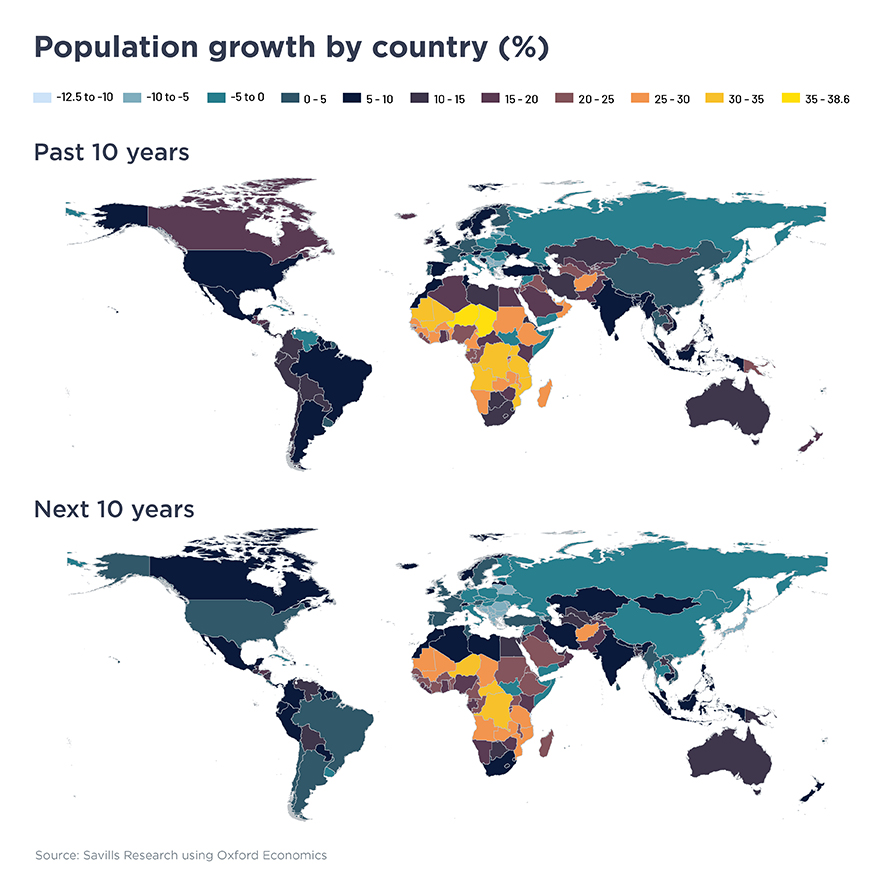
After a long period of sustained growth, the global population is likely to peak and then fall within this century, with huge implications for public finances, labour markets and real estate. Developed markets are already experiencing falling populations, a phenomenon we will start seeing in emerging economies over the next ten years.
But populations are continuing to grow in some regions. Africa, for example, is experiencing a rapid demographic and urban transformation that is set to generate significant opportunities. Locations with rising populations will likely benefit from increased investment, business formation and economic growth over the coming decades.
2. Global fertility rates have more than halved over the past 70 years
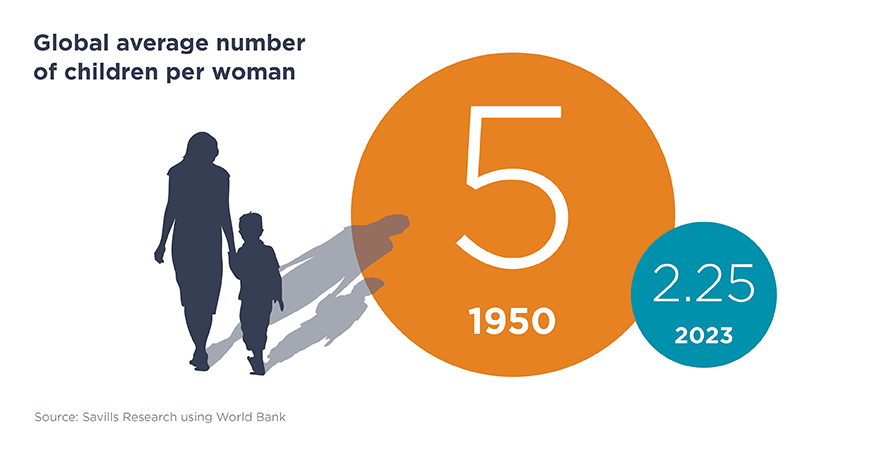
The total fertility rate has fallen from around five children per woman globally in 1950 to 2.25 children in 2023. The economic implications are significant: fewer births today means fewer working-age adults in 15 or 20 years.
A priority for businesses will therefore be to retain the talent they already have, including working parents. “Many parents, particularly mothers, leave or reduce their hours because of childcare pressures,” says Yetta Reardon Smith, Director, Workplace and Design, Savills. “In an era of demographic decline, creating parent-friendly workplaces is no longer a nice-to-have, it’s a business essential.
“Take the energy company BP: in the UK, its family-friendly policies and on-site nursery mean almost 100% of mothers return after a second child, and 97% are still with the company five years after their first. That’s well above the UK average, and shows what’s possible when support like childcare, flexible leave and coaching is built into the workplace.”
3. India’s demographic dividend is set to drive growth for decades to come
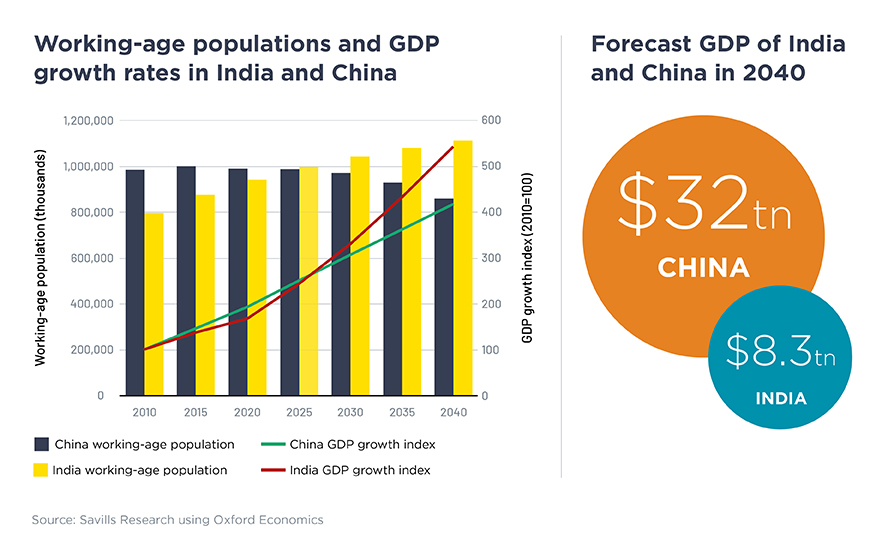
India’s working-age population is forecast to continue growing over the next 15 years. “India’s median age is around 28, with 67% of the population in the 15-64 age group,” says Arvind Nandan, Managing Director, Research and Consulting, Savills India.
“This demographic dividend is expected to remain its strongest point well into the latter half of this century. A high-skill base, thanks to a constant stream of STEM graduates, has facilitated the growth of global capability centres. With private consumption contributing over 60% of GDP, India will continue to witness growth in urbanisation, infrastructure, energy and services.”
4. People are moving, some cities are shrinking and populations are getting greyer
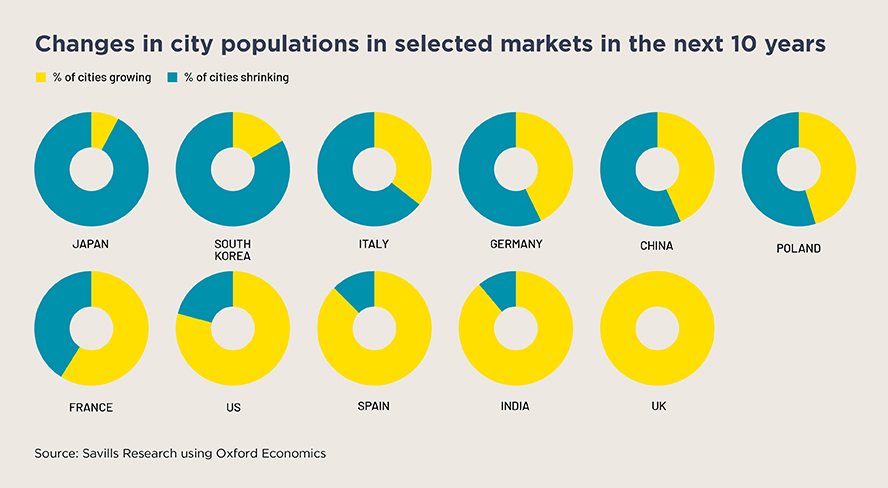
Population decline in China is uneven, shaped by strong internal migration. Around 57% of cities are expected to see population contraction over the next decade, as younger workers gravitate towards major economic hubs in search of better opportunities. “Young people are migrating to cities where jobs and industries are more concentrated,” says James Macdonald, Head of Research, Savills China. “That leaves many smaller cities facing both population loss and a rapidly ageing demographic.”
Rather than a simple decline, this reflects a broader redistribution. Policymakers are increasingly focused on managing the imbalance—supporting lower-tier cities while easing pressure on first-tier cities, where housing costs and infrastructure constraints remain acute. In response, investment is being directed towards local economies, particularly through the development of the ‘silver economy’ and service-led sectors, alongside initiatives to boost domestic tourism and consumption in smaller cities. “We’re also seeing early signs of people returning to their hometowns,” Macdonald adds. “They often bring back skills, capital and ideas developed in larger cities, supporting small business formation and more localised growth.”
5. Economies will face pressure to increase the proportion of the working-age population that is economically active
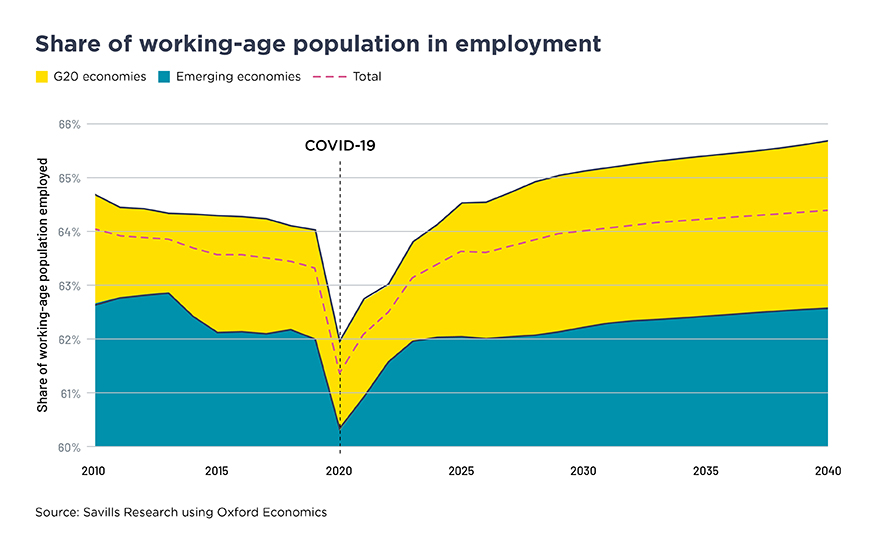
When populations fall and age, the dependency ratio (which compares the number of dependents with the working age population) increases. Currently, around a third of the working-age population globally is not in employment. A major challenge for economies in the coming decades will be increasing the proportion of people in work or shifting some tasks to new technologies such as AI or robotics.
6. Together, these trends will have a major impact on real estate in the coming decades
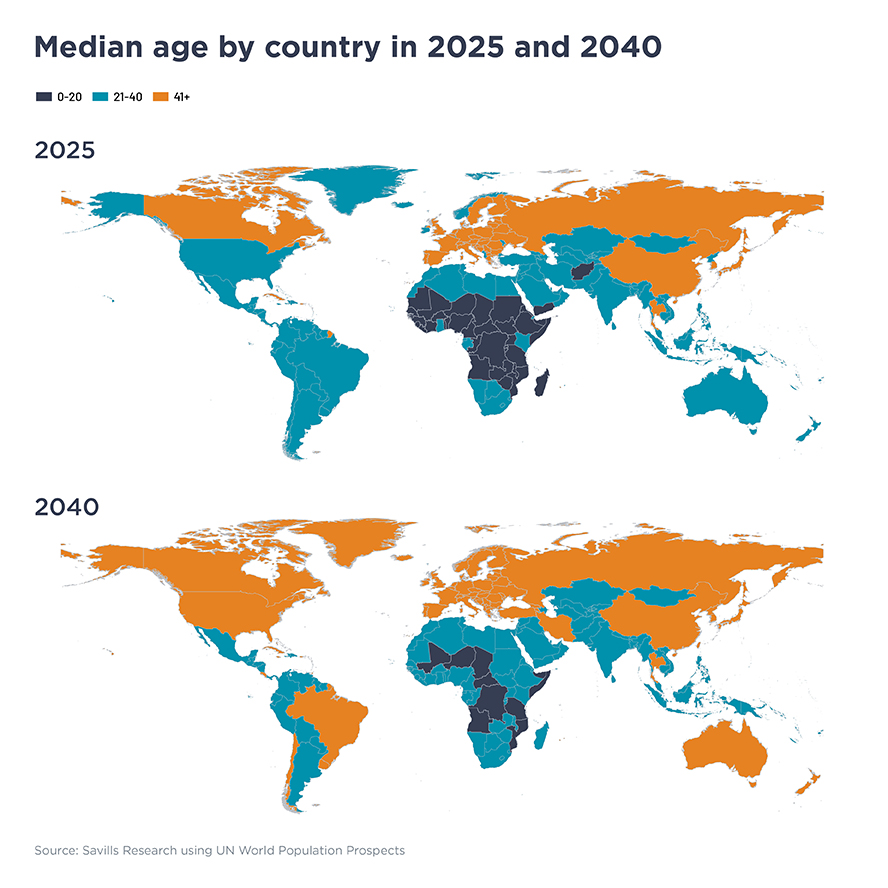
In many parts of the world, the median age is forecast to exceed 40 by 2040. The built environment will need to change to meet the residential, health and workplace needs of ageing populations and respond to trends such as declining household sizes, rural depopulation and shrinking workforces.
Their impact is already being seen in Asia Pacific, says Emily Fell, Senior Director, Asia Pacific Capital Markets, Savills. “Across cities in the region, demographic change is accelerating the repurposing of under-utilised offices, retail and hospitality assets,” she says. “As populations age, households shrink and urban mobility increases, converting existing buildings into rental, student, and senior living is becoming one of the most pragmatic and capital-efficient ways to meet future housing demand.”
7. Demographic change will resonate across sectors, including residential, retail, offices and logistics
In many markets, the challenge for real estate is rethinking how existing and new buildings can reflect the changing demographic reality.
The Netherlands, for example, is developing intergenerational real estate concepts that combine senior housing and childcare. “These demonstrate how the sector can respond to ageing populations while strengthening social cohesion and making more efficient use of space,” says Bas Wilberts, Head of Residential & Hotel Investment , Savills Netherlands.
“One of the key challenges in the Dutch housing market is limited residential mobility. Larger homes are often under-occupied, while downsizing options remain scarce. Addressing this mismatch is not only a policy issue, but an investment opportunity. By creating housing formats that enable downsizing and encourage intergenerational interaction, investors can contribute to improved market flow while achieving ESG objectives.”
How demographic changes will likely affect different real estate sectors
Jemil Dawodu
Associate Partner, Demola Dawodu and Associates property consultants, Lagos
“Africa’s rapid demographic and urban transformation presents one of the greatest opportunities of the 21st century. With 40% of Africans under the age of 14, its young population is poised to drive creativity, innovation and economic growth. By 2100, one in three babies will be born on the continent.
Africa is also the world’s fastest-urbanising region, with more than half of its people expected to live in towns and cities by 2035. This shift will generate wealth, expand business opportunities and inject new dynamism into urban centres.
By 2035, the continent will have six megacities: Lagos, Greater Cairo, Kinshasa, Greater Johannesburg, Luanda and Dar es Salaam. Each will be home to more than 10 million residents. These cities are emerging as powerful economic anchors, attracting skilled workers, global companies and rising levels of investment.
As they grow, they will play an increasingly central role in shaping Africa’s economic future through creating more dynamic and wealthier consumer markets, better-connected and more sophisticated commercial and distribution hubs, and larger bases for industrial production and global supply chains.”